 APPACS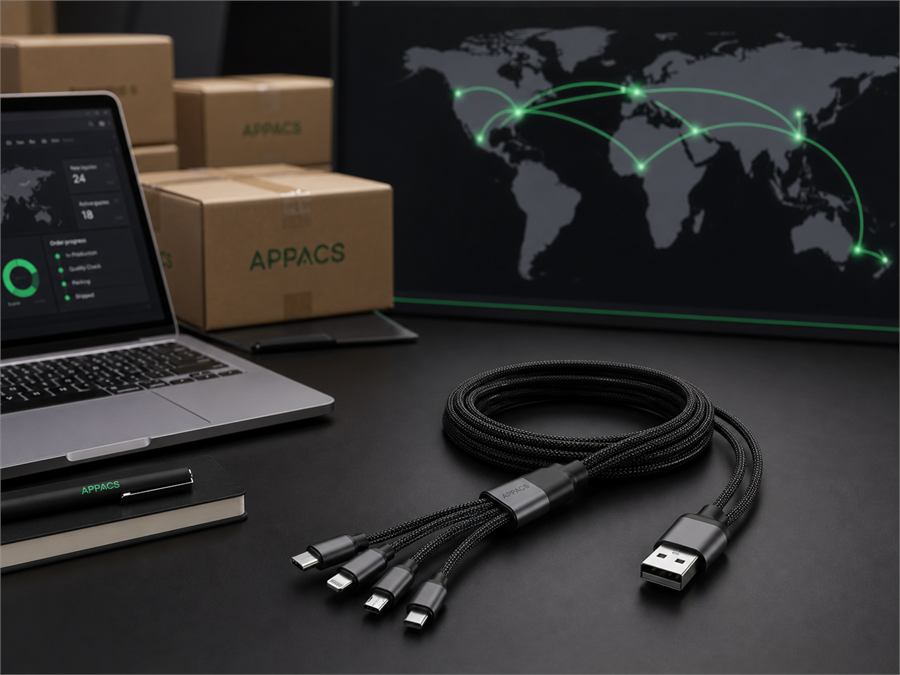
Choosing a USB cable manufacturer for bulk orders is not only about finding the lowest unit price. For importers, distributors, retail brands, promotional gift buyers and e-commerce sellers, the real decision is whether a supplier can deliver consistent product quality, stable communication, correct packaging, reliable lead time and useful support before mass production.
A charging cable looks simple from the outside, but buyers know small details can create big problems. A connector shell may look premium but loosen after repeated bending. A cable may claim fast charging support but fail under real device conditions. A sample may look acceptable, while the bulk shipment shows differences in color, logo position, cable texture or packing quality. These are the issues that professional buyers try to prevent before placing a purchase order.
This guide explains how to evaluate a USB cable manufacturer in a practical, B2B way. It is written for overseas buyers who are preparing to source USB-C cables, iPhone cables, 3-in-1 charging cables, braided fast charging cables or private label cable programs from a factory supplier.
Start with the Product Category You Really Need
Before contacting a supplier, define the cable category clearly. "USB cable" is too broad for a professional RFQ. A factory can respond more accurately if you identify the product family, connector type, wattage, cable material and packaging need.
Common product directions include:
- USB-C to USB-C cable
- USB-A to USB-C cable
- iPhone or Lightning cable
- 3-in-1 charging cable
- Watch charging cable
- LED display USB-C cable
- Braided fast charging cable
- Promotional gift cable
- Private label retail cable
For example, a buyer asking for a "3-in-1 charging cable for wholesale" should also clarify whether the product needs USB-A input, Type-C input, Lightning output, Micro USB output, USB-C output, 60W support, 100W support, special packaging or custom logo.
This is important because the right manufacturer is not only the one who has many catalog items. The right manufacturer is the one who can match your product scenario, target market and quality expectation.
Check Whether the Supplier Understands Bulk Buyer Requirements
A reliable USB cable manufacturer should communicate like a B2B supplier, not only like an online product seller. Bulk buyers normally need more than a product photo. They need to know:
- What is the exact model?
- What output or charging capacity does the product support?
- What material is used for the connector housing and cable jacket?
- Can the supplier support logo printing or engraving?
- Can packaging be customized?
- Is sample checking available before mass production?
- What information is needed for a quote?
- How are products checked before shipment?
If a supplier only sends a price list without confirming your intended use, quantity, cable type, packaging and destination market, the communication may not be mature enough for a long-term purchasing program.
For APPACS-style B2B cable sourcing, the ideal inquiry includes country, product model, target quantity, connector requirement, wattage expectation, packaging requirement, logo requirement and preferred contact method. This allows the factory team to evaluate feasibility and respond with a more realistic quotation.
Review Product Samples Before Bulk Production
Sample review is one of the most important steps in cable sourcing. A professional sample check should look beyond appearance. Buyers should test the cable in realistic use conditions and document feedback before confirming bulk production.
When reviewing a USB cable sample, check:
- Connector fit and plug-in feel
- Cable flexibility and touch
- Braided jacket consistency, if applicable
- Aluminum alloy or zinc alloy housing finish, if applicable
- Charging behavior with compatible devices
- Data transmission support, if the product claims it
- Logo position and clarity
- Package size, printing and barcode layout
- Color consistency against the approved sample
- Any visible burrs, scratches, loose parts or poor assembly
For fast charging cables, sample testing should be done with compatible chargers and devices. If a cable is described as 60W, 100W or 240W, buyers should confirm the use conditions and avoid assuming all devices will show the same charging behavior.
Experience note: in real sourcing projects, many problems are easier to fix during the sample stage than after mass production. Connector color, logo size, package artwork, cable length and surface finish should be confirmed early.
Understand Materials and Build Quality
Cable quality is strongly connected to material choices. Different markets and price levels may require different materials, but the supplier should be able to explain the product clearly.
Important material points include:
- Cable jacket: PVC, TPE, silicone, nylon braided or other materials
- Connector housing: plastic, aluminum alloy, zinc alloy or mixed structure
- Cable OD: outer diameter affects hand feel, durability and product positioning
- Strain relief: the transition between connector shell and cable body
- Cable length: common retail lengths include 1m, 1.2m and 2m, depending on product type
- Connector type: USB-A, USB-C, Lightning, Micro USB or multi-connector combinations
For example, APPACS U87-3in1 uses a nylon braided cable and aluminum alloy housing, with 60W, 20V/3A max output and 1.2 meter length. These details help buyers understand where the product sits in the market: it is not just a generic cable, but a multi-device fast charging cable suitable for retail, travel and gift scenarios.
Ask About Factory Testing and Shipment Inspection
A trustworthy USB cable manufacturer should be able to describe how products are checked before shipment. The factory does not need to overstate its process, but it should communicate quality checks in clear terms.
Typical checks may include:
- Appearance inspection
- Connector assembly check
- Cable length check
- Charging test
- Data transmission test when applicable
- Logo and packaging check
- Carton and quantity check
- Shipment inspection before dispatch
For B2B buyers, shipment inspection is especially important. Even if the sample was approved, the bulk order should be checked against the confirmed specification. The buyer can request photos or videos of packaging, carton marks and finished goods before shipment.
This is where a supplier's experience becomes visible. A manufacturer that understands export orders will know that packaging, labeling and carton accuracy matter as much as the cable itself.
Evaluate OEM/ODM Capability
Many overseas buyers are not only sourcing a standard cable. They may need a product for their own brand, retail channel, online store, promotional campaign or regional distributor program.
OEM/ODM questions to ask:
- Can the product carry a custom logo?
- Which parts can be customized?
- What colors are available?
- Can cable length be adjusted?
- Can packaging be designed for retail?
- Can the supplier support barcode labels or market-specific labels?
- What information is needed to prepare a sample?
- What is the expected sample lead time?
For private label projects, logo and packaging should be handled carefully. Buyers should prepare vector logo files, packaging dimensions, barcode requirements, language requirements and any compliance text required by their market.
Compare Price with Total Sourcing Risk
Price is important, but buyers should compare total sourcing risk, not only unit cost. A cheaper cable may become expensive if it causes returns, poor reviews, shipment delays, packaging corrections or quality disputes.
When comparing quotations, look at:
- Product specification
- Material and build
- Packaging included or not
- Logo included or not
- Sample cost
- Lead time
- Minimum order quantity
- Inspection process
- Communication speed
- Export support
A good manufacturer should be able to explain what is included in the quote. If two suppliers quote very different prices, ask them to confirm the same specification. Sometimes the cheaper offer is based on a different cable material, lower packaging standard or different connector structure.
Make Your RFQ Easy to Answer
Suppliers respond faster when the inquiry is clear. A practical RFQ should include:
- Product type
- Target model or reference image
- Quantity
- Target market
- Cable length
- Connector type
- Output or charging expectation
- Cable material preference
- Logo requirement
- Packaging requirement
- Certification or compliance needs, if applicable
- Delivery timeline
- Contact details
Instead of writing "send me your best price for USB cable," a stronger RFQ would be:
"We are sourcing a 3-in-1 fast charging cable for retail distribution in South America. Please quote for 1,000 / 3,000 / 5,000 pcs. We need nylon braided cable, aluminum alloy housing, 1.2m length, custom logo and retail box option. Please also advise sample availability."
This type of message helps the supplier reply with useful details.
Practical Questions to Ask During Supplier Screening
When overseas buyers compare several USB cable suppliers, the questions should go beyond price. A professional screening process should help you understand how the supplier thinks, how they confirm product details and how they reduce risk before shipment.
Start with product confirmation. Ask whether the quoted cable supports charging only or charging plus data transmission. If it supports fast charging, ask under what device and charger conditions the output was checked. For example, a 60W cable normally needs a compatible charger, compatible device and correct protocol conditions before the buyer can experience the expected result. This type of answer is more useful than a simple "yes, it supports fast charging."
Then ask about sample consistency. If you approve a black nylon braided cable with a certain connector shell color, the bulk production should follow the approved sample as closely as possible. Buyers can ask the supplier how color, logo position, cable length and packaging are checked before packing. For retail buyers, packaging alignment and barcode label placement may be just as important as the cable itself.
Finally, ask about communication during production. A reliable supplier should be able to share basic production updates, sample photos, packing photos or shipment inspection references when needed. This does not mean every order requires a complex inspection report. It means the supplier should understand that importers need visibility before goods leave the factory.
For APPACS-style B2B cable sourcing, the best supplier conversation usually starts with a clear RFQ, moves to sample review, then confirms bulk production details and shipment packing. This workflow gives both buyer and factory a shared reference and reduces misunderstandings.
FAQ
What is the most important thing to check before choosing a USB cable manufacturer?
Check whether the supplier can provide a sample, explain the product specification clearly, support your packaging needs and describe how products are tested before shipment.
Should importers choose the cheapest USB cable supplier?
Not always. Unit price should be compared with specification, material, packaging, QC process, lead time and communication quality. The lowest price may not be the lowest total sourcing risk.
What should I include in a USB cable RFQ?
Include product type, quantity, connector type, cable length, output requirement, material, logo need, packaging requirement, destination market and contact details.
Can USB cable manufacturers support private label projects?
Many manufacturers can support private label projects, but buyers should confirm logo method, packaging options, sample process and MOQ before placing a bulk order.
Conclusion
Choosing a USB cable manufacturer for bulk orders is a sourcing decision that should balance product quality, factory communication, customization ability, sample support and shipment reliability. Buyers should not rely only on product photos or price lists. A reliable supplier should help you confirm the right specification, test samples, prepare packaging and reduce risk before mass production.
For overseas buyers, the best first step is to prepare a clear RFQ and ask the supplier to respond with product details, sample options and quotation tiers.
CTA
Need help sourcing USB-C, iPhone or 3-in-1 charging cables for your market? Send APPACS your product requirement, target quantity, packaging needs and destination country. Our team can help review the right cable direction and prepare a quotation.
CTA Button: Get a Quote Secondary CTA: Ask for Product Catalog
Back to Blog