 APPACS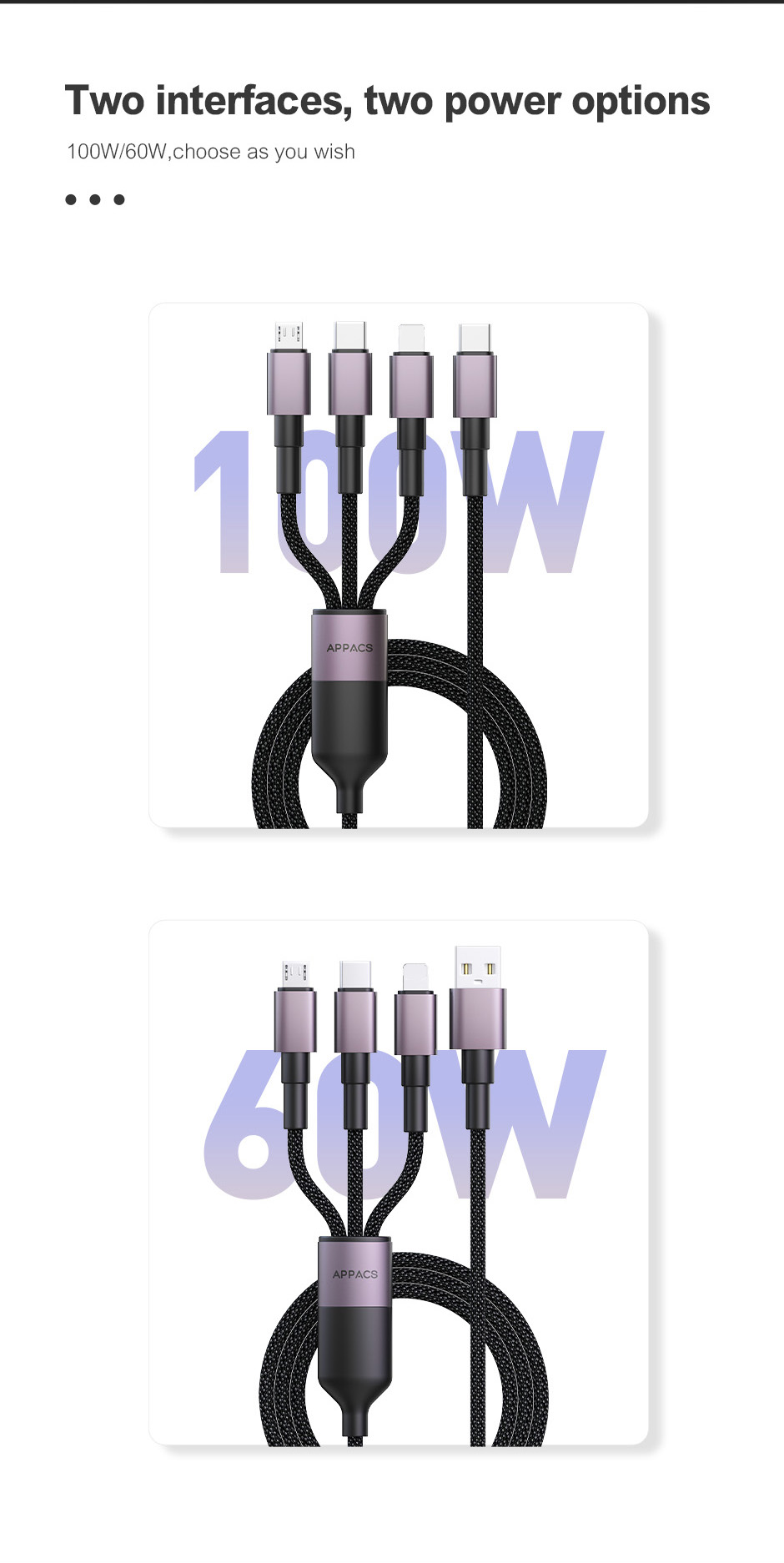
For importers and distributors, a 3-in-1 USB cable can be a strong product because it solves a simple buyer problem: one cable can support multiple device types. It is useful for travel, office desks, retail accessories, promotional gift sets and e-commerce bundles. But when buyers compare 60W and 100W versions, the sourcing decision becomes more technical.
The best choice is not always the highest wattage. A 100W cable may be attractive for premium positioning, but a 60W cable may be more suitable for mainstream phone and accessory markets, depending on device compatibility, retail price target, cable structure, connector design and customer expectations.
This guide explains how importers can compare 60W and 100W 3-in-1 USB cables in a practical way before placing bulk orders.
What Is a 3-in-1 USB Cable?
A 3-in-1 USB cable usually combines multiple output connectors in one cable. Common connector combinations include:
- USB-C
- Lightning
- Micro USB
- Watch charging module in some designs
- USB-A or USB-C input depending on the model
The goal is convenience. Instead of carrying separate cables for different devices, the user can carry one cable for multiple charging needs.
For wholesale buyers, this type of product is often used in:
- Mobile accessory stores
- Travel retail
- Promotional gifts
- Online marketplace bundles
- Corporate gift programs
- Distributor catalog lines
- Private label cable collections
However, "3-in-1" does not automatically mean every connector supports the same charging speed or data function. Buyers should read the specification carefully and ask the supplier to confirm the actual function of each connector.
What Does 60W Mean?
A 60W cable usually refers to maximum supported power under compatible charging conditions. For APPACS U87-3in1, the provided specification is 60W, 20V/3A max. This means the cable is positioned for fast charging use when matched with compatible devices and chargers.
In real applications, the charging result depends on:
- Device charging protocol
- Charger output
- Cable design
- Connector use
- Whether multiple devices are charging together
- Battery level and device power management
For importers, 60W is often strong enough for phone-focused markets and many daily charging scenarios. It can be easier to position for mainstream consumers who want convenience, durability and fast charging without needing a laptop-focused 100W product.
What Does 100W Mean?
A 100W cable is generally positioned as a higher-power product. It may be attractive for buyers who want to market premium fast charging capability, especially for USB-C devices that can use higher wattage.
But importers should be careful. A 100W claim should be supported by product design and supplier explanation. Buyers should ask:
- Which connector supports the stated output?
- Under what charging conditions is the output possible?
- Does the cable support data transmission?
- What devices are suitable?
- What testing can the supplier provide?
- Is the cable construction appropriate for the claimed wattage?
For retail markets, a 100W label can be useful, but it also creates higher customer expectations. If the product is sold to buyers who do not understand device compatibility, customer support questions may increase.
60W vs 100W: How to Compare for Sourcing
Target Customer
Choose 60W if your customer base is mainly phone users, travel accessory buyers, gift buyers or general mobile accessory shoppers.
Choose 100W if your customer base expects higher power capability, premium USB-C charging and more technical product positioning.
Retail Price Point
60W products may be easier to position in value-to-midrange retail channels.
100W products may work better in premium channels, tech accessory stores or private label lines where buyers expect advanced specifications.
Product Simplicity
60W is often easier to communicate to mainstream users. The message can focus on multi-device charging, fast charging and convenience.
100W requires clearer explanation. Buyers should avoid oversimplified claims if only certain connectors or device conditions support high wattage.
Sample Testing
Both 60W and 100W products should be sample tested. Buyers should check charging behavior with representative devices and chargers. Testing should be documented before mass production.
Why 60W Can Be a Practical Choice
The APPACS U87-3in1 60W cable is a good example of a mainstream multi-device product. It has:
- APPACS brand
- U87-3in1 model
- 60W, 20V/3A max output
- Nylon braided cable
- Aluminum alloy housing
- 3.8mm OD
- 1.2 meter length
- Support for 3 devices charging together
This set of specifications supports a clear product story: durable material, multi-device convenience and fast charging for compatible devices.
For many importers, this is enough to build a retail product page, distributor catalog entry or promotional offer. The product does not need to overpromise. It can be positioned around convenience, construction and practical fast charging.
When 100W May Be Better
100W may be the better option when the buyer wants:
- Premium fast charging positioning
- Higher perceived value
- USB-C heavy product line
- Laptop or tablet charging use cases
- A higher-end accessory collection
However, 100W products should have strong specification support. Buyers should request sample testing and ask the factory to clarify which connector supports which function.
Connector and Function Clarity Matters
One common sourcing mistake is assuming every connector on a 3-in-1 cable performs the same way. In reality, connector functions can vary. Some connectors may focus on charging, while data transmission may be limited or supported only by specific ports depending on the design.
Before confirming a purchase order, buyers should ask:
- Which connector supports fast charging?
- Which connector supports data transmission?
- Can multiple devices charge together?
- What is the output when multiple devices are connected?
- Is the input USB-A or USB-C?
- Are there 60W and 100W variants?
Clear function notes reduce customer misunderstanding and after-sales questions.
Product Application Scenarios
Travel and Everyday Use
A 3-in-1 cable is convenient for users carrying multiple devices. A 60W version can be attractive for everyday phone and accessory charging.
Corporate Gifts
Promotional buyers often value usefulness, packaging and logo customization. A 3-in-1 cable can be more memorable than a single connector cable.
Distributor Catalogs
Distributors can use 60W and 100W versions to create different price tiers.
E-commerce Bundles
Online sellers can bundle a multi-connector cable with travel adapters, chargers or power banks.
How to Write the Product Page
For SEO and AI search, the product page should explain the product in direct language:
- What is the model?
- What is the output?
- What materials are used?
- What is the cable length?
- What devices or scenarios is it suitable for?
- What can be customized?
- What should buyers include in an inquiry?
Avoid vague claims like "best quality" or "super fast for all devices." Instead, use specific and reliable wording, such as "supports up to 60W, 20V/3A max under compatible charging conditions."
How Importers Should Brief a Supplier for 60W or 100W Models
The fastest way to get a useful quotation is to brief the supplier with the buyer's real commercial objective. If you only ask, "How much is your 3-in-1 cable?", the supplier may quote a general model that does not match your target market. If you explain the channel, expected retail positioning and packaging need, the supplier can recommend a more realistic specification.
For a 60W inquiry, tell the supplier whether the cable is mainly for phone accessories, travel retail, promotional gifts or distributor catalog sales. Confirm whether the product should support three devices charging together, whether data transmission is needed, and whether the cable will be sold in neutral packaging or private label packaging.
For a 100W inquiry, clarify whether your customers expect laptop charging or simply a premium-looking cable. If laptop charging is part of the sales message, ask the supplier to explain compatibility conditions clearly. The product page and packaging should avoid implying that every device will always charge at 100W. A more trustworthy statement is that the cable supports up to a stated wattage under compatible charger and device conditions.
Importers should also ask for sample testing before committing to large quantities. In a practical sample review, check connector fit, cable flexibility, braided texture, surface finish, charging behavior, packaging layout and barcode label position. If the product will be sold online, prepare photos that show the connector types clearly, because buyers often misunderstand multi-connector cables when the product image is unclear.
This brief-first approach helps both buyer and factory. The buyer receives a quotation that matches the market, while the supplier avoids guessing and can prepare better product recommendations.
FAQ
Is a 100W 3-in-1 cable always better than a 60W cable?
No. The better choice depends on target customers, retail price point, device use and product positioning.
Can a 3-in-1 cable charge three devices at the same time?
Some models can support three devices charging together. Buyers should confirm this with the supplier and test samples before mass production.
What should importers test before ordering 3-in-1 cables?
Test charging behavior, connector fit, cable flexibility, material finish, logo position and packaging.
Is 60W enough for mobile accessory distribution?
For many phone-focused markets, 60W can be a practical fast charging position, especially when the product also offers multi-device convenience.
Conclusion
For importers, the choice between 60W and 100W 3-in-1 USB cables should be based on market positioning, customer needs, product clarity and supplier support. A 60W cable can be an excellent mainstream product when buyers need practical fast charging, multiple connectors and competitive retail positioning. A 100W cable can serve premium markets, but it requires clearer technical explanation and sample testing.
The safest sourcing process is to define your market, test samples, confirm connector functions and prepare clear packaging claims before mass production.
CTA
Looking for a 60W or 100W 3-in-1 USB cable for your market? Send APPACS your target quantity, connector requirement and packaging plan. We can help recommend a suitable product direction.
CTA Button: Send Your Requirements Secondary CTA: View U87-3in1 Product
Back to Blog